

What if the darkening of your most cherished silver piece wasn't a flaw but a quiet confirmation of its purity? It's a common worry when you open a velvet lined box to find a once brilliant pendant has turned a dull, shadowed grey. You might find yourself questioning the quality of the metal or wondering why does silver jewellery tarnish despite your best efforts to keep it safe. In reality, this shift in colour is a natural dialogue between the sterling silver and the world around it. It's an organic process that affects even the finest 925 hallmarked pieces, which must contain 92.5 percent pure silver to meet the ISO 9202:2019 international standard.
We understand the frustration of seeing a favourite crinkled cufflink or a delicate halo ring lose its evocative shine. You want to preserve the light that first drew you to the piece. This guide will reveal the chemical secrets behind oxidation and provide you with peace of mind that your jewellery is indeed genuine. We'll explore how environmental factors react with the copper in the alloy and share actionable, artisan approved steps to maintain that luminous finish. By the end, you'll have a clear ritual for preventing future dullness and protecting your collection for years to come.
Key Takeaways
- Understand that tarnish is a natural surface reaction called oxidation. It is a quiet confirmation of your metal's authenticity rather than a sign of a permanent defect.
- Learn exactly why does silver jewellery tarnish by identifying the invisible environmental factors, such as atmospheric sulphur and humidity, that accelerate the darkening process.
- Discover how the copper alloy in 925 sterling silver provides the necessary strength for daily wear whilst influencing the metal's unique, evolving patina over time.
- Explore how handcrafted textures, such as those found in our Struck or Crinkled collections, can be aesthetically enhanced by subtle oxidation that adds depth to the design.
- Master simple, mindful rituals to preserve beauty. Practising the "last on, first off" rule ensures the evocative lustre of your favourite pieces remains untarnished.
Understanding the Natural Evolution of Silver Tarnish
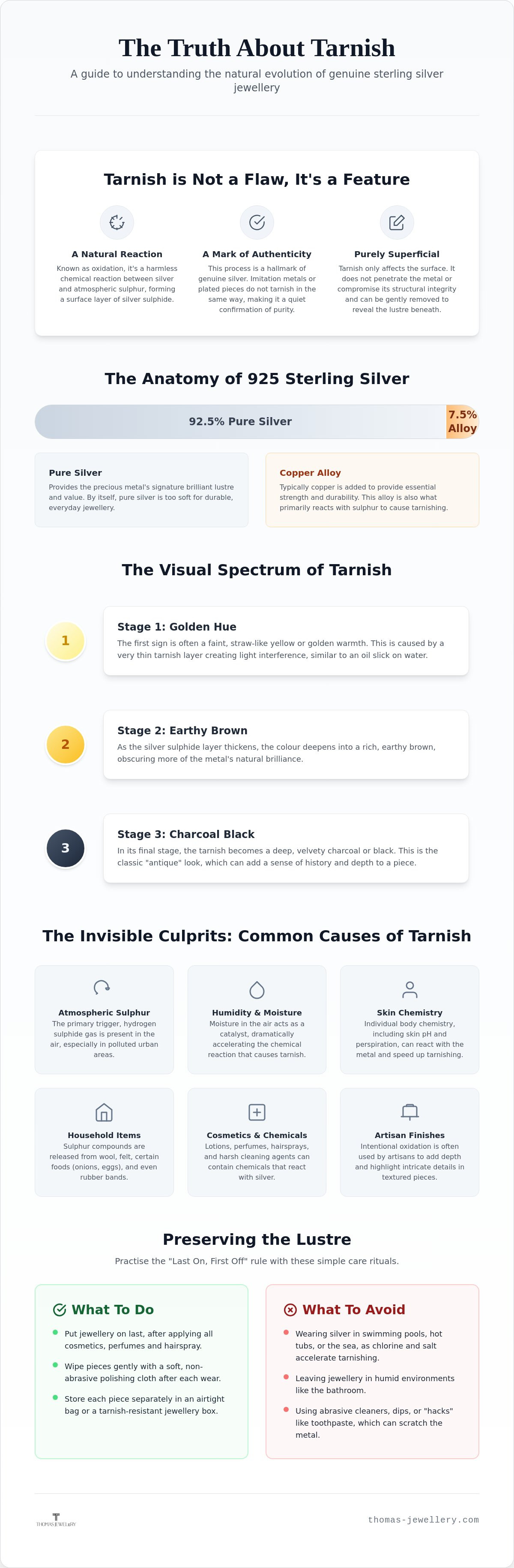
To look at a piece of silver is to witness a material that is constantly in motion, quietly breathing in the world around it. Whilst we often view the sudden appearance of a dark film as a sign of neglect, Understanding the Natural Evolution of Silver Tarnish reveals that this process is entirely natural. Tarnish is a chemical reaction known as oxidation; specifically, it is the formation of silver sulphide. It occurs when the silver atoms on the surface of your jewellery encounter sulphur gases in the atmosphere. Far from being a defect, this reaction is a hallmark of authenticity. Only genuine silver reacts this way. It proves your piece is not a base metal masquerading as something finer.
One of the most common anxieties for collectors is the fear that their jewellery is being permanently ruined. However, tarnishing is strictly a surface level event. It does not penetrate the core of the metal or compromise its structural integrity. It's a delicate skin that can be removed to reveal the original lustre beneath. When you ask yourself why does silver jewellery tarnish, it's helpful to view it as a dialogue between the metal and its environment. It's a visual record of the air you breathe and the places you visit.
The Science of Silver Sulphide
At a microscopic level, the silver on your skin is engaged in a slow dance with sulphur particles. These particles are inescapable, found in everything from city air to certain foods and fabrics. When they meet, they bond to create a microscopic film that settles across the metal. Silver sulphide is the primary component of tarnish that forms when silver meets sulphur gases. This film starts as a transparent layer, but as it thickens, it begins to obscure the silver's innate brilliance.
The Spectrum of Tarnish Colours
The visual transformation of silver is rarely immediate; instead, it follows a predictable, almost painterly spectrum. You might first notice a faint, golden warmth or a straw like yellow hue. This is the result of thin film interference, where light waves bounce off both the tarnish layer and the silver surface, creating a shimmering play of colour. As the silver sulphide layer grows thicker, the yellow deepens into a rich, earthy brown. Eventually, the piece settles into a deep, evocative charcoal or velvet black. This final stage is what many associate with antique silver, providing a sense of history and weight to the design. By understanding this progression, you can catch tarnish in its earliest, most golden stages or choose to embrace the dramatic depth of its darker tones.
The Invisible Culprits: Sulphur, Humidity, and Daily Life
Whilst we can see the result, the cause is often a ghost in the room. Atmospheric sulphur remains the primary, inescapable reason behind the darkening of your favourite pieces. It's a persistent presence in the air, drifting through our homes and streets without a sound. Understanding The Chemistry of 925 Sterling Silver reveals how hydrogen sulphide gas bonds with the metal surface, creating that characteristic patina. Moisture and humidity act as silent catalysts in this process, providing the damp environment needed to accelerate the chemical reaction. This is particularly noticeable in the British climate, where the air often holds a heavy, damp quality that encourages tarnish to bloom faster than in drier regions.
Your own skin plays a subtle role too. Personal chemistry varies wildly amongst individuals; some people possess a more acidic skin pH that reacts more readily with silver. If you've ever wondered why does silver jewellery tarnish more quickly on you than on a friend, it's likely down to these unique biological markers. It's a natural interaction, a sign that your jewellery is living alongside you.
Environmental Triggers in the British Home
Our homes are filled with surprising sources of sulphur. Woollen carpets and upholstery contain proteins that off-gas over time, whilst the kitchen can be a hotspot for reactive compounds. Simple daily rituals, such as peeling onions or boiling eggs, release sulphur into the air that can settle on a nearby Bubbles of Chapel Down pendant. In urban centres, air pollution adds another layer of complexity, as city smog often carries higher concentrations of the gases that dull silver's evocative lustre.
Cosmetic and Chemical Interactions
The products we use to feel our best can often be the most taxing for our jewellery. Perfumes, hairsprays, and lotions create a sticky residue that coats the silver, effectively trapping reactive gases against the metal. This makes it harder for the silver to breathe and significantly speeds up oxidation. Chlorine is perhaps the most aggressive culprit. Whether it's a dip in a swimming pool or a relaxing soak in a hot tub, the harsh chemicals can cause rapid, uneven discolouration. It's best to adopt the artisan's rule: apply your favourite scent and let it dry completely before putting on your jewellery. This simple pause ensures your pieces stay radiant for longer. By being mindful of these invisible triggers, you can better understand why does silver jewellery tarnish and take small, meaningful steps to protect the beauty of your collection.
The Chemistry of 925 Sterling Silver and Copper Alloys
To understand the soul of a piece of jewellery, one must look closely at its composition. Whilst pure silver possesses a luminous lustre that is unmatched by other metals, its inherent softness makes it unsuitable for the rigours of modern life. It's like working with soft clay; a ring made of fine silver would lose its shape within days of wear. To give the metal the strength it needs to endure, we must blend it with other elements. This is the foundation of what is 925 sterling silver, a precise alloy that has been the standard of excellence for centuries.
The "925" refers to the fact that the metal is 92.5 percent pure silver. The remaining 7.5 percent is an alloy, almost always copper. This small addition transforms the silver, providing the structural integrity required for intricate designs. However, this strength comes with a trade off. Copper is significantly more reactive than silver. It acts as a primary catalyst for oxidation, eagerly bonding with the sulphur gases in the air. When you ask why does silver jewellery tarnish, the answer often lies in this necessary copper content. The copper reacts with the environment even before the silver does, leading to that gradual shift in colour we see over time.
Why We Use Sterling Silver for Artisan Work
For an artisan, sterling silver is the perfect canvas. It offers a delicate balance between durability and the metal's natural, ethereal glow. This specific alloy allows for the creation of complex, tactile impressions, such as the deep ridges found in our Struck Collection or the organic folds of our crinkled designs. Pure silver would be too malleable to hold such crisp detail. By using the sterling standard, we honour a tradition of British silversmithing that dates back to the 12th century, ensuring each piece is both a work of art and a lasting companion.
Alloy Variations and Tarnish Speed
You might notice that certain pieces in your collection darken at different rates. This variation often stems from the specific alloy mix used by the maker. Whilst copper is the traditional choice, some modern alloys experiment with different metals to slow the process. However, the myth that "tarnish free" silver exists without sacrificing purity is just that; a myth. Any metal containing high levels of silver will eventually react with the atmosphere. The most reliable way to ensure you are receiving genuine precious metal is to look for the hallmark. This small, stamped signature is your guarantee of quality, confirming that the piece meets the rigorous standards of 925 sterling silver. Understanding this chemistry helps us appreciate that tarnish is not a sign of poor quality, but a natural result of the metal's strength and authenticity.
How Artisan Textures and Finishes Interact with Oxidation
Whilst a high polish surface reflects the world like a mirror, artisan textures invite the world in. On a smooth, mirror finished piece, tarnish appears as an unwelcome smudge that disrupts the light. On textured jewellery, however, the process is far more nuanced. The way tarnish behaves depends entirely on the topography of the metal. Instead of a uniform dullness, oxidation tends to settle into the deeper recesses, leaving the raised peaks to be polished by the natural friction of your daily movements. This creates a beautiful, high contrast effect that can actually make a piece feel more sculptural and defined over time.
For those who wear crinkled silver rings UK, this interaction is part of the design's evolution. The tarnish finds a home in the organic valleys of the texture, adding a sense of shadow and history that a factory made piece could never replicate. It's one of the primary reasons why does silver jewellery tarnish in such a visually rewarding way on handcrafted items. Many artisans even use "deliberate oxidation" during the making process, intentionally darkening the metal before polishing back the highlights to ensure the detail is immediately evocative.
The Beauty of the Struck and Crinkled Finishes
Light plays differently across a textured surface. When tarnish begins to settle, it enhances the contrast between the shimmering highlights and the shadowed depths. This patina makes the jewellery feel "extraordinary" and lived in, as if it has its own story to tell. From an artisan's perspective, this isn't a defect to be feared but a transformation to be observed. A little oxidation can ground a piece, taking it from a bright, cold object to something with intimate warmth and character. It reflects a life well lived amongst the quiet moments of the mundane.
Managing Tarnish on Intricate Designs
Cleaning pieces with complex surfaces, such as the Bubbles of Chapel Down collection, requires a gentler touch than a simple flat band. The challenge lies in removing unwanted dullness from the highlights without stripping away the beautiful depth in the recessed areas. Soft brushes are essential here. A very soft, old toothbrush can reach into those textured "bubbles" to lift away dust and excess sulphur without scratching the silver. You aren't aiming for a return to a clinical, brand new state; you're maintaining a balance. Distinguishing between a "beautiful patina" that highlights the texture and "unwanted tarnish" that makes the piece look neglected is a personal choice. If you feel your collection is losing its spark, you can explore our Struck Collection to see how we use these textures to celebrate the natural life of sterling silver.
Preserving the Lustre: From Prevention to Gentle Restoration
Caring for silver is less a chore and more a ritual of appreciation. Now that we understand the chemical reasons for why does silver jewellery tarnish, we can turn our attention to the simple, mindful habits that keep it radiant. The most fundamental of these is the "last on, first off" rule. By making your jewellery the final touch of your morning routine and the first thing you remove at night, you shield it from the perfumes, lotions, and hairsprays that accelerate oxidation. Curiously, one of the most effective ways to prevent tarnish is simply to wear your pieces often. The gentle friction of your skin and clothing acts as a natural polisher, buffing away the very earliest stages of silver sulphide before they can settle into a dark film.
This approach ensures that your handcrafted items, from a delicate Halo Ring to a bold cocktail piece, remain as luminous as the day they left the workshop. It's about working with the metal's nature rather than against it. When you aren't wearing your collection, the focus shifts to creating a protective sanctuary for each piece.
Daily Habits for Long-Lasting Shine
The way you rest your jewellery at the end of the day is just as important as how you wear it. It's tempting to leave a favourite piece on a bedside table or a bathroom shelf, but these open spaces expose the metal to the very gases that cause dullness. Learning how to store silver jewellery to prevent tarnish is essential for maintaining that evocative shine over the long term. By controlling the environment, you address the core reason why does silver jewellery tarnish even when it's not being worn.
Avoid the bathroom at all costs; the high humidity from daily showers acts as a powerful catalyst for the tarnishing process. Instead, wipe each piece down with a soft, lint free cloth to remove skin oils before placing it in an airtight container. Small zip lock bags or felt lined boxes kept in a dry, cool drawer are ideal. These simple steps prevent the air from reaching the surface, pausing the dialogue between the silver and the atmosphere.
The Artisan’s Approach to Cleaning
When the time comes to restore the lustre of a textured piece, a gentle touch is paramount. Aggressive chemical dips should be avoided for handcrafted silver; they can strip away the intentional depth of the design and leave the metal looking clinical and flat. For pieces from our Butterflies or Struck collections, the best approach is often the simplest. A bowl of warm water mixed with a drop of mild, phosphate free soap can lift away daily grime without harming the metal. To understand the finer details of this process, you can read our guide on how to clean handcrafted silver jewellery. Once the piece is dry, use a specialised silver polishing cloth to buff the high points of the texture. This allows the natural oxidation in the valleys to remain, preserving the sculptural contrast that makes artisan silver so extraordinary.
Embrace the Evolving Beauty of Your Silver
Understanding why does silver jewellery tarnish transforms a common frustration into a moment of connection with your collection. We've seen that this darkening is simply a natural reaction between the copper in your 925 sterling silver and the atmosphere; it's a quiet testament to the metal's purity and life. Whether you're wearing a piece from our Struck collection or a delicate Halo Ring, remember that tarnish isn't a defect but a surface patina that can be gently managed or even celebrated for the depth it adds to artisan textures.
By adopting a few mindful rituals, such as the "last on, first off" rule and proper airtight storage, you ensure your favourite pieces continue to elevate the mundane moments of your daily life. If you're ready to add a new story to your collection, we invite you to explore our collection of contemporary handcrafted silver jewellery. Each piece is uniquely handcrafted in the UK with sustainably minded artisan craftsmanship, designed to be a lasting companion. Wear your silver with confidence, knowing its lustre is always within reach.
Frequently Asked Questions
Is it a sign of poor quality if my silver jewellery tarnishes?
Tarnishing is a natural characteristic of genuine silver and is certainly not a sign of poor quality. In fact, only authentic silver reacts with atmospheric sulphur to form that distinctive dark patina. Base metals or heavily plated items often behave differently; so seeing your piece darken slightly over time is a quiet confirmation that you are wearing a real precious metal rather than a synthetic imitation.
Can I prevent my silver from tarnishing if I don’t wear it?
You cannot stop the process entirely whilst air is present, but airtight storage will significantly slow the rate of oxidation. When left in an open jewellery box, your silver is constantly exposed to the gases that cause dullness. Using small zip-lock bags or specialised anti-tarnish pouches creates a protective barrier, ensuring your favourite pieces remain radiant even when they aren't being worn for a season.
Why does my silver jewellery turn my skin green or black?
This discolouration is usually caused by a reaction between your skin's natural acidity and the copper found in 925 sterling silver. When you wonder why does silver jewellery tarnish or leave a mark, it's often due to personal chemistry, lotions, or high humidity. The resulting silver salts or copper oxides can leave a temporary dark or green shadow on the skin, which is harmless and easily washed away with soap.
Does 925 sterling silver tarnish faster than 999 pure silver?
Sterling silver does tarnish more readily than 999 pure silver because of its 7.5 percent copper content. Pure silver is naturally more resistant to oxidation, but it is far too soft for the structural demands of artisan jewellery. The addition of copper provides the necessary strength for intricate designs, even though it makes the metal more reactive to the sulphur particles found in our everyday environment.
How often should I clean my handcrafted silver pieces?
You should only clean your handcrafted pieces when you notice the light beginning to dim or a golden hue appearing on the surface. For daily wearers, a quick wipe with a soft, lint-free cloth after each use is often enough to keep tarnish at bay. Over-cleaning can be abrasive, so it's best to wait until the metal's natural glow needs a gentle, mindful restoration to its original state.
Can humidity in the UK affect my silver jewellery tarnish rate?
The damp UK climate definitely accelerates the rate at which your silver will darken. Moisture in the air acts as a catalyst, helping sulphur gases bond more quickly to the metal surface. If you live in a coastal area or keep your jewellery in a humid room like a bathroom, you'll likely find that you need to clean your pieces more frequently to maintain their evocative shine.
Is it safe to use baking soda and aluminium foil to clean silver?
Whilst this chemical dip is a popular home remedy, it can be too aggressive for delicate handcrafted work or pieces with intentional dark detailing. The process can strip away the depth that gives artisan textures their character, leaving the metal looking unnaturally white and flat. For textured collections, we always recommend a gentler approach using mild soap or a specialised polishing cloth to maintain the design's integrity.
Why does some silver jewellery turn yellow before it turns black?
This yellowing is the earliest stage of oxidation, caused by a very thin layer of silver sulphide settling on the surface. As light waves bounce off this microscopic film, they create a golden or brown interference pattern. If left unpolished, this layer will continue to thicken, eventually transitioning into the deep, velvet black that we recognise as full tarnish. Catching the process at this golden stage makes cleaning effortless.