

Pure silver is a quiet paradox. It possesses a moon-like glow that captures the light beautifully, yet in its most honest form, it's far too soft to withstand the tactile demands of a daily life. You've likely felt that hesitation when choosing a new piece, wondering what is 925 sterling silver and if that tiny engraving is a genuine promise of quality. It's natural to feel a bit lost amongst the different grades, especially when you simply want a piece that tells your story without the anxiety of it turning green or losing its shape.
In this guide, we'll demystify why this specific alloy remains the definitive choice for artisans who value both elegance and endurance. You'll discover the precise composition that gives this metal its strength, how to verify authenticity through the UK's rigorous hallmarking standards, and the gentle care routines that preserve its radiant lustre for years to come. From the weight of a Halo Ring to the delicate texture of our Butterflies Collection, we'll help you find the confidence to choose jewellery that truly lasts a lifetime.
Key Takeaways
- Understand the precise composition of the alloy, learning what is 925 sterling silver and why the addition of copper is essential for creating durable, wearable art.
- Discover why artisans prefer this metal for its unique ability to become stronger through hand-sculpting, allowing for the intricate textures found in pieces like the Struck collection.
- Learn how to verify the authenticity of your silver by identifying the legal UK hallmarks and understanding the role of the independent Assay Offices.
- Master the simple, non-abrasive techniques required to maintain your jewellery's radiant lustre, including the benefits of wearing your pieces daily.
- Explore the enduring value of sterling silver as a sustainable choice for those seeking to build a collection of meaningful, modern heirlooms.
What is 925 Sterling Silver? Defining the Standard of Purity
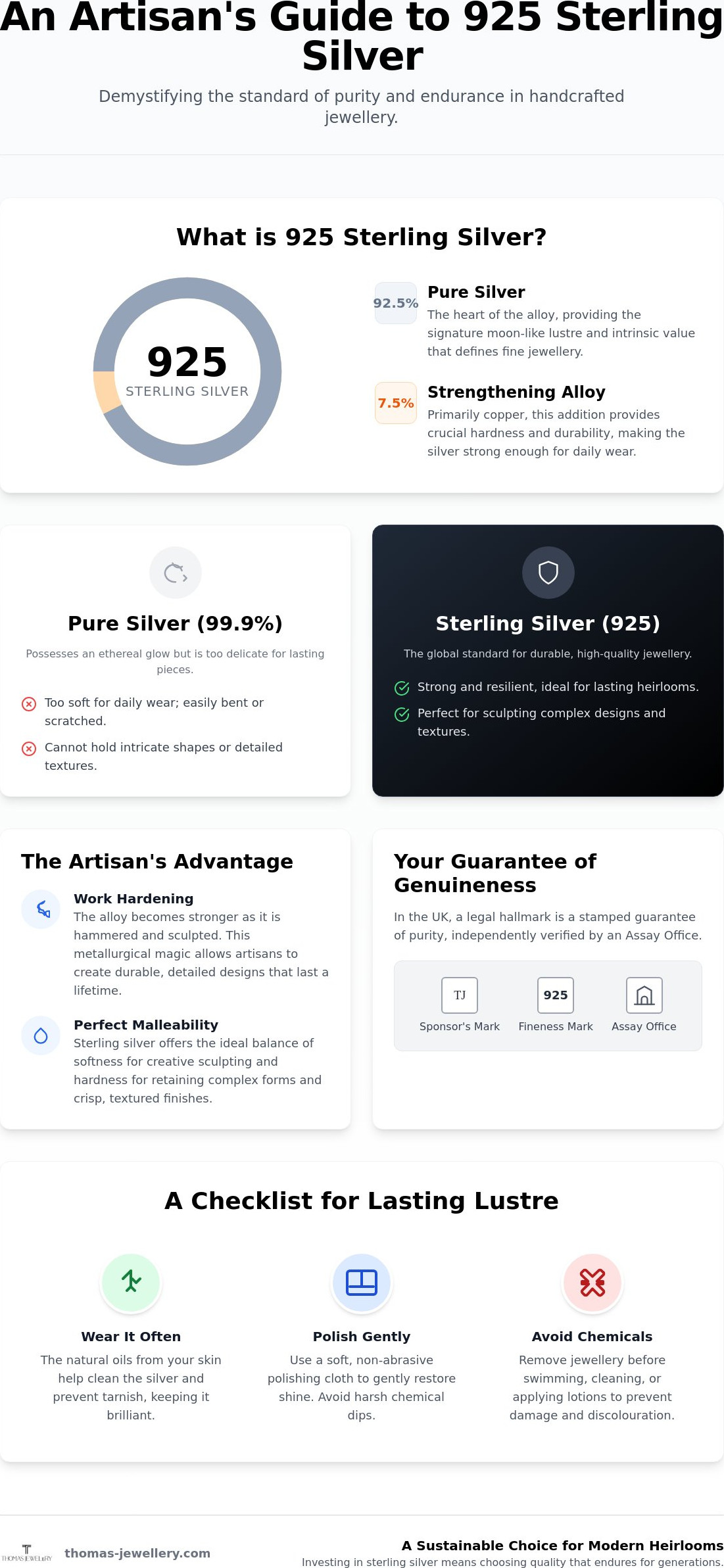
To understand the allure of a handcrafted ring or a textured pendant, one must first look at the alchemy within the metal itself. At its most basic level, Sterling silver is an alloy; a deliberate blend of metals designed to overcome the limitations of nature. If you've ever questioned what is 925 sterling silver, it's simply a ratio of 92.5% pure silver and 7.5% other metals, usually copper. Whilst fine silver, which is 99.9% pure, possesses an ethereal, almost liquid glow, it's notoriously delicate. In the workshop, pure silver is so soft that it yields under the slightest pressure, making it unsuitable for the intricate details or the structural integrity required for pieces like a Halo Ring.
The 'Sterling' name carries the weight of centuries, tracing its roots back to 12th-century England. It was a standard born of necessity, ensuring that currency remained sturdy enough for trade whilst retaining its intrinsic value. By introducing a small amount of base metal, early silversmiths found they could create objects that were both beautiful and functional. This historical transition from pure, soft metal to a resilient alloy allowed for the creation of the first family heirlooms, setting a benchmark that remains unchanged in the modern studio.
The 92.5% Rule: Why Purity Matters
The numerical hallmark '925' refers to the millesimal fineness of the metal. It indicates that 925 parts out of 1,000 are pure silver, whilst the remaining 75 parts consist of other metals. This specific ratio is the global standard for high-end jewellery because it offers the perfect balance between value and resilience. When people ask what is 925 sterling silver, they are essentially looking for a guarantee of substance.
Unlike silver-plated items, which merely hide a base metal under a microscopic layer of silver, or 'silver-filled' pieces that use mechanical bonding, genuine sterling silver represents a solid, consistent quality throughout the entire object. It's a material that can be polished, repaired, and passed down through generations without the fear of a surface layer wearing away to reveal something less beautiful beneath.
Copper and Zinc: The Silent Partners in the Alloy
Copper is the traditional artisan's choice for that vital 7.5% of the alloy. It acts as a silent partner that introduces the necessary hardness to the silver without compromising its iconic, cool white lustre. Without this addition, the delicate wings of the Butterflies Collection would bend, and the crisp edges of the Struck Collection would soften with every touch. Copper provides the structural backbone that allows an artisan to hammer, twist, and sculpt the metal into complex forms.
While some modern alloys might include small amounts of zinc or germanium to help resist tarnish, copper remains the favourite for its predictable workability under the hammer. It allows the metal to undergo 'work hardening', a process where the silver actually becomes stronger as it's shaped by the artisan's tools. 925 sterling silver is a hallmark of quality that balances ancient beauty with modern durability.
The Artisan’s Choice: Why We Sculpt in 925 Sterling Silver
Choosing a material is a quiet, deliberate conversation between the maker and the medium. For those of us dedicated to the craft of handcrafted silver jewellery UK, the decision to work in this specific alloy is never arbitrary. When you ask what is 925 sterling silver from the perspective of the workshop, it represents a unique malleability that allows us to capture the fluid, imperfect lines of the natural world. It moves under the heat of the torch and the weight of the hammer with a grace that pure silver simply cannot sustain. This metal is our canvas, offering enough softness to be sculpted into organic forms whilst possessing the grit to hold those shapes through the decades.
The magic of the material lies in how it responds to the artisan's touch. Every strike of a hammer or pull of a file changes the metal on a molecular level. This is where the metallurgy of Sterling Silver becomes a vital part of the creative process. Through a phenomenon known as work hardening, the alloy actually grows stronger as it is manipulated. It remembers the pressure of the tools, transforming from a soft, yielding wire into a resilient, structural piece of art. It's a partnership where the maker provides the vision and the metal provides the enduring strength.
Capturing Texture: From Struck to Crinkled Finishes
In the studio, we look for ways to make metal feel alive. The 925 alloy is exceptional because it holds the 'memory' of a hammer blow with incredible clarity. In our Struck Collection, each facet is a deliberate moment in time, creating a surface where light plays across handcrafted ridges like sunlit water. If we were to use fine silver, these delicate details would quickly soften and blur with daily wear. Sterling silver ensures that the crisp, evocative textures of our Crinkled Cufflinks remain as sharp and tactile as the day they left the bench.
Durability for Daily Life
Jewellery shouldn't be fragile; it's meant to be lived in and loved. Whether it's the bold presence of our Cocktail Rings or the intricate settings of a silver halo ring UK, the structural integrity of the metal is paramount. The 7.5% copper content provides the necessary tension to hold gemstones securely in place, preventing the claws from shifting or bending. Understanding what is 925 sterling silver means recognising its ability to evolve with the wearer. It picks up a soft, unique patina over time that tells your story, all whilst remaining robust enough to withstand the mundane knocks and scrapes of a life well-lived.
Perhaps you'll find a piece in our collections that resonates with your own journey, ready to grow more beautiful with every passing year.
How to Identify Genuine 925 Sterling Silver in the UK
Finding the hallmark on a piece of jewellery is like uncovering a secret signature from the maker. On a Halo Ring, you'll usually find it tucked inside the band, whilst on earrings, it often sits discreetly on the post or the butterfly back. This tiny engraving is your first step in understanding what is 925 sterling silver in a practical, everyday sense. It's a declaration of purity, but in the UK, the story of authenticity goes much deeper than a simple numerical stamp. It's about a legacy of consumer protection that dates back centuries.
While the FTC guidelines on sterling silver offer a solid international foundation for purity standards, the British system is uniquely rigorous. A '925' mark on its own is often just a manufacturer's claim. To be truly certain of a piece's heritage, you should look for a full hallmark. This is especially vital for larger items, as the independent verification process ensures the metal lives up to its name before it ever reaches your collection. In the UK, any silver item over 7.78 grams must be hallmarked by law.
The Anatomy of a UK Hallmark
A complete UK hallmark is a triptych of history and geography. It includes the Sponsor’s Mark, which is the unique mark of the company or person who sent the item; the Fineness Mark, which is the 925 shield; and the Assay Office Mark. Whether it's the leopard's head of London, the anchor of Birmingham, the Yorkshire rose of Sheffield, or the castle of Edinburgh, these symbols act as a badge of authenticity and heritage. For an artisan, these marks are a point of pride, proving that their work meets the highest standards of the Hallmarking Act 1973.
Sensory Tests for Authenticity
If you're at home and want to verify a piece, your senses are often the best tools. Real sterling silver has a high-pitched, bell-like ring when gently tapped, a sound quite different from the dull thud of base metals. You can also try the scent test; genuine silver should never have a strong metallic or 'copper' smell, as this often indicates a high proportion of other alloys or simple plating. Another fascinating method is the ice test. Because silver has the highest thermal conductivity of any metal, a piece of ice placed on a sterling silver surface will begin to melt almost instantly.
You can also use a strong magnet; silver is diamagnetic and shouldn't stick. Finally, a simple rub with a soft white cloth can be revealing. Genuine silver oxidises slightly when exposed to air, so a tiny amount of black residue on the cloth is actually a good sign that you're holding the real thing. These quiet observations help you feel confident in what is 925 sterling silver, transforming a technical specification into a tangible experience of quality.
The Shiny Silver Checklist: Keeping Your Jewellery Radiant
Owning a piece of handcrafted jewellery is like tending a small, silver garden; it requires consistent, gentle acts of care to flourish. Because the alloy contains 7.5% copper, it's naturally susceptible to oxidation when exposed to the air. Understanding what is 925 sterling silver involves accepting that tarnish isn't a flaw or a sign of poor quality. It's simply a chemical reaction. The secret to a lifetime of lustre lies in your daily habits and knowing when to give your collection a thoughtful refresh. When treated with respect, the metal doesn't just stay shiny; it develops a beautiful, soft character that reflects your personal journey.
Perhaps the most delightful rule of silver care is to wear your pieces often. Your skin's natural oils act as a subtle, protective barrier that helps prevent the metal from dulling. It's the reason a ring you wear every day often appears brighter than a pendant left at the bottom of a jewellery box. However, you should remain vigilant against harsher elements. Chlorine in swimming pools, salt water, and even the sulphur in certain household cleaning products can be aggressive, causing your silver to darken far more rapidly than usual.
Daily Habits for Lasting Lustre
To keep your collection in pristine condition, adopt the 'Last On, First Off' rule. This means your jewellery should be the very last thing you put on after your perfume, hairspray, and lotions have completely dried. These cosmetic chemicals are often the primary culprits behind premature tarnishing. After you take your pieces off, give them a quick wipe with a soft, lint-free cloth to remove any traces of the day. Finally, be wary of the 'bathroom trap'. Whilst it's convenient to leave your items on a vanity, the high humidity from the shower is an enemy to 925 silver. Instead, discover how to store silver jewellery to prevent tarnish in a cool, dry environment.
The Deep Clean: A Safe Artisan Method
When your silver begins to lose its moonlit spark, a gentle deep clean can restore its original radiance. We recommend avoiding liquid 'dips', as these can be too abrasive and may strip away the intentional oxidation used to define textures in artisan work. Instead, follow this simple checklist:
- Fill a small bowl with lukewarm water and add a single drop of phosphate-free dish soap.
- Submerge your jewellery and let it soak for five to ten minutes to loosen surface debris.
- Use a very soft-bristled brush to gently clean around intricate details or gemstone settings.
- Rinse the piece thoroughly under clean, running water to remove all soap residue.
- Pat the metal dry immediately with a soft, clean cloth to prevent water spots or streaks.
For a final touch of brilliance, a professional polishing cloth is perfect for buffing the raised facets of our Cocktail Rings back to a mirror-like finish.
Investing in 925 Sterling Silver: The Modern Heirloom
In a world that often moves too fast, choosing a piece of jewellery becomes a quiet act of intention. When we look past the technicality of what is 925 sterling silver, we find a material that champions the slow and the sustainable. Unlike the fleeting allure of gold-plated 'fast fashion' that inevitably loses its coating and ends up forgotten, sterling silver is a noble metal with a circular life. It can be melted down, refined, and reborn into something new without ever losing its intrinsic worth. For the modern collector, it represents a conscious choice to invest in quality that doesn't just last a season, but endures for a lifetime.
The true beauty of silver lies in its ability to carry a narrative. It's a metal that responds to your touch, growing more beautiful as it develops a soft patina that mirrors your own experiences. Whether it's the weight of a Halo Ring or the delicate flutter of the Butterflies Collection, these aren't just accessories; they're tangible markers of moments, milestones, and memories. By choosing this alloy, you're opting for a material that balances the ethereal glow of the moon with the structural resilience needed to survive the journey of a life well-lived.
Beyond the Metal: The Value of Craftsmanship
The '925' mark is merely the beginning of a piece's story. Whilst mass-produced items are cast by the thousands in cold, industrial moulds, artisan jewellery is born from a different rhythm. Small-batch work carries the spirit of the maker, from the first spark of inspiration to the final polish at the bench. When you choose a handcrafted piece, you're supporting a tradition of excellence that values the evocative beauty of the human hand over the sterile perfection of a machine. This connection transforms a simple object into a part of your personal history, ensuring your jewellery feels as unique as the story it tells.
Starting Your Artisan Collection
Building a collection is a gradual, rewarding process of finding pieces that resonate with your soul. You might begin with a single statement piece, perhaps one of our bold Cocktail Rings that catches the light during a quiet evening, or the subtle texture of the Bubbles of Chapel Down Collection. From there, you can begin to layer different textures to create a look that is uniquely yours. Mixing the crisp, geometric facets of the Struck Collection with smooth or hammered finishes creates a curated aesthetic that feels both modern and timeless.
Ultimately, what is 925 sterling silver if not the perfect medium for nature inspired silver jewellery? It captures the fleeting patterns of the world around us and turns them into wearable botanical art. We invite you to explore our handcrafted collections and find a piece that makes your ordinary days extraordinary.
A Radiant Future for Your Artisan Collection
Now that you understand what is 925 sterling silver, the mystery of the hallmark transforms into a mark of quiet confidence. You've discovered that this specific blend of purity and strength is what allows for the intricate, nature-inspired textures that define a contemporary heirloom. By knowing how to verify authenticity through British hallmarking and maintain that signature lustre through simple, daily habits, you can ensure your pieces remain as evocative as the day they were first sculpted. The anxiety of tarnishing fades when you realise that your jewellery is designed to be a resilient part of your journey.
Choosing jewellery is an act of storytelling. Whether you're captivated by the hammered facets of our Struck Collection or the delicate lines of our Butterflies, our pieces are intended to be lived in and loved. We invite you to discover the beauty of handcrafted 925 sterling silver at Thomas Jewellery. Every piece is handcrafted in the UK, featuring contemporary artisan designs and arriving with secure UK shipping on all orders. May your collection grow with you, capturing the light and the memories of every extraordinary day.
Frequently Asked Questions
Does 925 sterling silver tarnish over time?
Yes, sterling silver naturally tarnishes when it's exposed to sulphur and oxygen in the air. This chemical reaction creates a dark layer of silver sulphide on the surface of the metal. Whilst it might seem like a flaw, it's actually a sign of the metal's authenticity. You can easily manage this by wearing your jewellery often, as the natural oils in your skin help prevent the oxidation process from taking hold.
Can I wear 925 sterling silver in the shower or pool?
You should generally avoid wearing your jewellery in the shower or swimming pool. Whilst pure water isn't the primary enemy, the chemicals found in tap water, soaps, and especially chlorine can accelerate tarnishing. Chlorine is particularly aggressive and can cause permanent damage or pitting to the metal's surface. To keep your pieces radiant, it's best to remove them before any water based activities.
Is 925 sterling silver hypoallergenic for sensitive skin?
Genuine 925 sterling silver is widely considered hypoallergenic because it doesn't contain nickel, which is the most common cause of metal allergies. The 7.5% alloy is typically copper, a metal that is generally safe for sensitive skin. If you have a known copper allergy, you might experience a reaction, but for the vast majority of wearers, sterling silver remains a comfortable and safe choice for daily wear.
What is the difference between sterling silver and 925 silver?
There is no functional difference between the two; they are simply different names for the same standard of purity. When someone asks what is 925 sterling silver, they are referring to the alloy containing 92.5% pure silver. "Sterling" is the traditional name for this standard, whilst "925" is the modern millesimal fineness mark used by artisans and hallmarking offices to denote the metal's quality.
How can I tell if my silver jewellery is real at home?
You can verify your jewellery by looking for the 925 stamp or a full UK hallmark. At home, a strong magnet is a useful tool; genuine silver is not magnetic and shouldn't stick. You can also try the ice test by placing a cube on the metal. Because silver is an incredible thermal conductor, the ice will begin to melt almost instantly, far faster than it would on a base metal surface.
Why does my 925 silver ring turn my finger green sometimes?
A green mark on your finger is usually caused by a reaction between the copper in the alloy and the acids or moisture on your skin. This isn't a sign of poor quality or fake metal. High humidity, certain lotions, or even changes in your body's pH levels can trigger this oxidation. Keeping your skin dry and ensuring your ring is clean can significantly reduce the likelihood of this happening.
Is 925 sterling silver worth anything?
Understanding what is 925 sterling silver helps explain why it holds genuine intrinsic value as a precious metal. Whilst it is more affordable than gold or platinum, it remains an investment that can be recycled and repurposed. Beyond the raw metal value, artisan pieces like those in the Struck Collection carry additional worth due to the craftsmanship, heritage, and unique design involved in their creation.
How often should I clean my sterling silver jewellery?
You should give your jewellery a quick wipe with a soft cloth after every wear to remove oils and salts. A more thorough clean using lukewarm water and mild soap is usually only necessary every few months, or whenever you notice the lustre beginning to dim. Establishing a regular, gentle routine prevents heavy tarnish from building up, making it much easier to maintain that moon-like glow.