

Could the rhythmic strike of a hammer against cold metal be the secret to a piece that carries more soul than any factory-moulded trinket? Many jewellery lovers find themselves puzzled when faced with textured surfaces, often wondering what is struck silver jewellery and whether those intentional marks are signs of quality or merely a rugged aesthetic. You might feel that common high-street designs lack a certain character, yet you worry that a hammered finish could be less durable than a smooth one. It's a common hesitation, born from a desire to invest in something that's both beautiful and built to endure.
In this guide, you'll discover the rhythmic artistry and enduring strength behind struck silver jewellery and why this ancient technique remains a favourite for contemporary designers. We'll look at the physical transformation of the metal, moving from the technical markers of quality to the evocative, light-catching textures that define the artisan's work. By the end, you'll understand how these deliberate impressions create a structural integrity that cast silver simply can't match, allowing you to choose your next piece with confidence and a quiet sense of wonder.
Key Takeaways
- Gain a clear understanding of what is struck silver jewellery and how the rhythmic impact of the hammer creates a piece with a soul far beyond mass-produced alternatives.
- Learn about the delicate balance of heat and pressure in the annealing process, where metal is made malleable enough to capture the silversmith's intent.
- Identify the quality markers that set struck pieces apart from cast jewellery, including a density and strength that resists the common pitfalls of porosity.
- Appreciate the practical beauty of textured sterling silver, which offers an organic elegance that gracefully disguises the inevitable marks of a life well-lived.
- Explore how heritage techniques are reimagined in the Struck Collection, honouring the traditional tools of the anvil and stamp in contemporary, wearable forms.
Defining Struck Silver Jewellery and the Art of Silversmithing
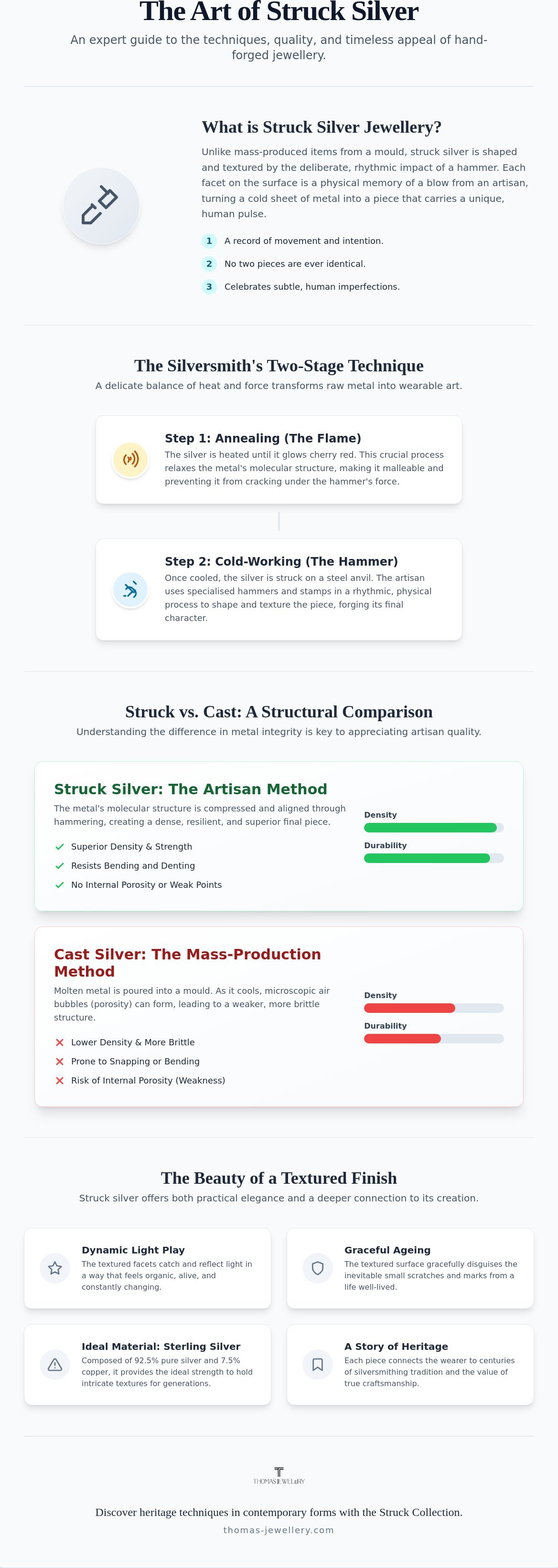
When you hold a piece of jewellery that feels alive, you're likely feeling the echoes of the hammer. To understand what is struck silver jewellery, one must look past the surface and consider the physical journey of the metal itself. Unlike mass-produced items that emerge from a clinical, uniform mould, struck silver is shaped and textured through deliberate, rhythmic impact. It is a record of movement. Every dimple, ripple, and facet on the surface is a physical memory of a blow delivered by an artisan, turning a cold sheet of metal into something that carries a human pulse.
In the UK, this technique is deeply woven into the Art of Silversmithing, a heritage craft that has remained largely unchanged for centuries. Whilst modern retail often favours high-shine, mirrored surfaces that can feel distant or detached, the sensory appeal of a struck surface is intimate and grounding. It invites you to run your thumb across its landscape, catching the light in a way that feels organic rather than manufactured. For those who seek something beyond the predictable offerings of the high street, the term "struck" has become a synonym for artisan quality, signifying that a piece was born from effort and intention.
The Role of the Silversmith
The relationship between the silversmith, the hammer, and the silver is a silent, focused dialogue. As the hammer meets the metal, the artisan isn't just changing a shape; they're capturing a specific moment in time. No two strikes are identical. This means that every piece carries its own unique rhythm, ensuring that no two items can ever be truly the same. It's this dedication to the singular that drives our craft. We believe that by celebrating these subtle, human imperfections, we can make ordinary days feel extraordinary, turning the simple act of putting on a ring or a pair of earrings into a moment of connection with a handmade story.
Sterling Silver: The Ideal Canvas
To achieve this evocative level of detail, 925 sterling silver remains the favourite choice for struck designs. It's a precise alloy, composed of 92.5% pure silver and 7.5% other metals, typically copper. This small addition of copper is vital; it provides the structural strength required to withstand the repeated, forceful impact of the hammer without the metal becoming brittle or cracking. This inherent durability is a hallmark of handcrafted silver jewellery UK, ensuring that the intricate textures created at the anvil today will remain crisp and beautiful for generations to come.
The Silversmith’s Technique: How Struck Jewellery is Created
The journey of a struck piece begins not with a hammer, but with a flame. To understand the intricate process behind what is struck silver jewellery, one must first appreciate the delicate state of the metal before the first blow is even struck. Raw sterling silver is naturally resilient; however, repeated striking causes the molecular structure to compress and harden, a phenomenon known as work-hardening. To keep the silver receptive to the artisan's intent, it must undergo annealing. This involves heating the metal until it glows a soft, cherry red, effectively relaxing its internal structure. Annealing is the essential step that prevents the metal from cracking under the hammer.
Once the silver has been softened and cooled, the "cold-working" phase begins. This is where the true character of the piece is forged. Resting the silver upon a heavy steel anvil, the silversmith uses a variety of specialised tools, from broad-faced planishing hammers to delicate, textured steel stamps. Unlike the fluid heat of the casting process, this stage is rhythmic and physical. Every strike is a conscious decision, a moment where the artisan observes how the metal moves and reacts. You can see this dedication to the craft in the Struck Collection, where the final form is a direct result of this patient, manual dialogue.
Hand-Struck vs. Die-Struck
There is a significant distinction between the industrial world and the artisan's bench that often goes unmentioned. Mass-produced items, such as coins or medals, are frequently die-struck, a process where a machine uses immense hydraulic pressure to force metal into a pre-made steel mould. Whilst this ensures perfect uniformity, it lacks the soul of the hand-struck method. As a creative observer, you might notice that hand-striking is a fluid, artisan-led process. It results in one-off textures that can never be perfectly replicated, making every piece a unique expression of the day it was made. This focus on advanced metal forming techniques is a cornerstone of professional silversmithing, often explored in depth when comparing Struck vs. Cast Jewellery.
The Alchemy of Texture
The final aesthetic of the piece is determined by the "alchemy" of the hammer. A highly polished, slightly convex hammer head will create broad, soft indentations that catch the light in gentle pools; conversely, a cross-pein hammer can produce sharp, linear textures that mimic the grain of wood or the ripple of water. These indentations do more than just look beautiful; they play with light and shadow, giving the silver a three-dimensional depth that a flat surface lacks. In the final finishing stages, the silver is often lightly polished or subtly oxidised to further highlight these struck marks, ensuring the story of its creation is visible to all who see it.
Struck vs. Cast Jewellery: Understanding the Structural Differences
In the quiet corners of the jewellery world, a subtle debate exists between the fluid efficiency of casting and the disciplined impact of striking. Most contemporary pieces are created through casting, a process where molten silver is poured into a pre-shaped mould to cool and solidify. Whilst this allows for intricate, three-dimensional shapes, it often introduces a hidden weakness: porosity. As the liquid metal cools, tiny air bubbles can become trapped within the structure, leaving the finished piece less dense and more prone to snapping or pitting under pressure.
When you ask what is struck silver jewellery, you're looking at the antithesis of this method. Rather than relying on a liquid state, striking works with the metal whilst it is solid. This physical manipulation triggers a process called work-hardening. Every blow from the hammer compresses the silver’s molecular structure, pushing the atoms closer together until the metal becomes significantly denser than its cast counterparts. This is the secret behind why struck jewellery is often thinner and more delicate in appearance yet remains remarkably stronger and more resilient during daily wear. It is a transformation from a soft, malleable sheet into a hardened, durable object.
Durability and Longevity
Choosing a piece that has been forged at the anvil is an investment in longevity. Because the striking process eliminates the risk of internal air pockets, the resulting silver is far less likely to bend out of shape or develop stress fractures over time. It doesn't just sit on the skin; it endures. We view these pieces as sustainable, "lifetime" purchases. They are objects designed to be worn every day, weathering the years with a quiet strength that mass-produced, cast items simply cannot replicate. The compressed nature of the metal ensures that a slim, hand-struck ring will hold its circular form long after a cast band of the same thickness has begun to warp.
Visual Integrity
The difference in manufacturing also manifests in how a piece interacts with the world around it. Textures that are "cast-in" often appear soft or slightly blurred, as they are merely a secondary copy of a wax original. In contrast, struck textures possess a sharp, crystalline crispness. The facets created by the hammer are primary marks, existing as direct evidence of the artisan's force. This creates a unique play of light. A struck surface doesn't just reflect brightness; it shimmers with a rhythmic intensity. You can see this same dedication to crisp, intentional texture in our guide to crinkled silver rings UK, where the metal is manipulated to capture light in its most evocative form.
The Aesthetic Appeal of Textured Sterling Silver
Beyond the structural strength discussed previously, there's a profound visual poetry to this method. When exploring what is struck silver jewellery, one quickly discovers an organic elegance that feels deeply connected to the natural world. These pieces don't possess the clinical, mirrored perfection of mass-produced items; instead, they offer a landscape of soft indentations and rhythmic ripples. It's a contemporary style that feels both ancient and remarkably fresh, bringing a sense of quiet character to a jewellery box that factory-moulded pieces often lack.
There is a practical magic to this aesthetic that many owners only appreciate after weeks of wear. Because the surface is already intentionally textured, the inevitable tiny scratches and scuffs of daily life simply blend into the existing pattern. Rather than "damaging" the piece, these marks of a life well-lived become part of its evolving story. This resilience makes struck silver an ideal choice for everyday wear, offering a rugged durability that remains sophisticated. It's a versatile look that transcends gender, suiting both masculine and feminine aesthetics with its honest, unpretentious beauty.
We often find that people are drawn to the tactile nature of these objects. There is an almost instinctive urge to run a fingertip across the surface, feeling the cool, undulating metal. This sensory connection transforms a simple accessory into a grounding object, a small piece of sculpture that travels with you throughout the day. It's this intimate relationship between the wearer and the work that defines the artisan experience.
Capturing Light and Shadow
The true allure of a struck surface lies in its shimmering, sculptural quality. By creating "peaks" and "valleys" in the metal, the silversmith organises how light interacts with the piece. In the deeper recesses, shadows pool, often enhanced by a subtle oxidation that adds a sense of weathered depth. Meanwhile, the raised edges catch every passing beam of light, creating a glimmer that shifts and changes as you move. This constant play of contrast gives the silver a three-dimensional vitality, ensuring it never looks flat or dull, even in the softest evening light.
Styling Struck Pieces
Whilst these designs are striking enough to stand alone, they also serve as the perfect foundation for a curated, layered look. You might consider mixing a heavily textured band with a smooth, polished ring to create a dialogue between different finishes. For those with a minimalist wardrobe, a single piece of struck silver can elevate a simple outfit into something extraordinary, providing a focal point that feels intentional rather than over-decorated. To find your own piece of this rhythmic artistry, you can explore the unique, handcrafted designs within our Struck Collection.
Discovering the Struck Collection at Thomas Jewellery
The Struck Collection at Thomas Jewellery is more than just a curated selection of accessories; it's our quiet, rhythmic tribute to the timeless relationship between the hammer and the anvil. Every piece within this collection is a physical manifestation of the techniques we've explored, born from a deep-seated desire to celebrate the raw, honest beauty of the silversmithing process. When you consider what is struck silver jewellery, you're looking at a story of the maker's hands. It is a narrative of patience and precision where every dimple and ripple is entirely intentional, ensuring that each item you choose is as singular as the moment it was forged in our British studio.
We believe that jewellery should be a reflection of the world around us, capturing the subtle wonders found in nature and the quiet moments of daily life. By choosing to strike the metal whilst it is solid, we preserve a density and strength that allows these pieces to be worn with a sense of confidence. This isn't just about fashion; it's about an appreciation for the mundane transformed into the extraordinary. Whether you're drawn to the way a textured surface catches the morning light or the grounding weight of a hand-forged band, this collection invites you to linger on the details and find a piece that truly resonates with your own journey.
Artisan Rings and Pendants
The rings within our collection possess a distinctive, tactile presence that sets them apart from the uniform curves of the high street. They aren't merely bands of metal; they're landscapes of texture that wrap around the finger, catching the light with a soft, shimmering intensity. Our pendants, meanwhile, serve as evocative focal points of light and shadow, designed to draw the eye and invite touch. Each one is a small, intentional sculpture, a piece of wearable art that carries the visible evidence of the silversmith's force. These designs ensure that even the simplest outfit is elevated, providing a focal point that feels both sophisticated and deeply personal.
The Perfect Gift
Finding a gift that carries genuine meaning can often feel like a challenge in a world of mass production. For those who appreciate the quiet elegance of heritage crafts and the story behind the object, the Struck Collection offers a thoughtful alternative. Knowing that a piece was struck by hand, rather than poured into a mould, adds a layer of significance that the recipient will feel every time they wear it. To make the experience of acquiring these pieces as relaxed as the craftsmanship is methodical, we offer various secure payment options including Apple Pay and PayPal. Combined with our national UK delivery, bringing a piece of this ancient artistry into your life, or the life of a loved one, is a simple and rewarding process.
We invite you to explore the unique textures and enduring strength of our handcrafted designs to find your own extraordinary piece of silversmithing history. Explore the Struck Collection
Embracing the Rhythmic Beauty of Hand-Struck Silver
Choosing a piece of jewellery is often a search for something that resonates with your own story. We've explored how the deliberate strike of a hammer creates a density and resilience that cast silver simply cannot offer, ensuring your chosen piece remains a steadfast companion for years to come. It is a record of movement. By honouring these heritage techniques, we transform raw sterling silver into a landscape of shimmering textures and deep shadows. Now that you've discovered what is struck silver jewellery, you can appreciate the quiet strength and tactile soul behind every intentional mark.
Our handcrafted contemporary designs are born from this methodical, contemplative process, resulting in wearable art that celebrates the extraordinary in the everyday. Whether you're looking for a gift with a narrative or a new focal point for your own collection, we invite you to linger over our work. With trusted payment options like PayPal and Apple Pay, and British craftsmanship at the heart of every piece, finding your next favourite treasure is a relaxed and rewarding journey.
Browse the Struck Collection at Thomas Jewellery
Frequently Asked Questions
What is the difference between struck and hammered silver?
Struck silver is the broader technical category, whilst "hammered" refers specifically to the most common visual finish created by this method. Whilst all hammered jewellery is struck, the striking process can also include the use of specialised steel stamps or punches to create more intricate, repetitive patterns. Both methods rely on the physical impact against an anvil to shape and harden the metal, resulting in a piece that carries the maker's unique rhythm.
Is struck silver jewellery more durable than cast jewellery?
Struck silver jewellery is significantly more durable than cast alternatives due to the molecular compression that occurs during the forging process. As the metal is repeatedly hit, it becomes denser and harder, a state known as work-hardening. This makes the finished piece far less likely to bend or snap, whereas cast items can contain tiny air bubbles that create hidden structural weaknesses over time. It is a choice for those who value longevity.
Does struck sterling silver tarnish more easily because of the texture?
The texture of struck silver doesn't cause it to tarnish faster, but the "valleys" in the surface can occasionally collect atmospheric sulphur more noticeably. However, this often adds a beautiful sense of depth as the recesses darken whilst the "peaks" remain bright. Regular wear against your skin actually helps keep the raised areas polished, maintaining the piece's natural shimmer and organic character without the need for constant maintenance.
Can I resize a struck silver ring?
Resizing a struck silver ring is certainly possible, though it requires a skilled hand to ensure the unique texture remains seamless. Unlike a smooth ring where a join can be polished away invisibly, a struck band may need the silversmith to carefully re-strike the area around the new join. This ensures the rhythmic pattern continues uninterrupted, preserving the piece's handcrafted integrity and visual flow. It is a delicate process of blending the old with the new.
How do I clean struck silver without ruining the texture?
To clean your jewellery without flattening its delicate peaks, use a soft-bristled toothbrush and a small amount of mild, eco-friendly washing-up liquid in warm water. Gently brush into the indentations to remove any oils or dust. Avoid using aggressive polishing cloths or abrasive pastes, as these can gradually wear down the sharp, light-catching facets that define the struck aesthetic. A gentle touch is all that's needed to restore its original glow.
Is struck jewellery always handmade?
Not all struck jewellery is handmade, as industrial "die-striking" uses hydraulic presses to mass-produce uniform items like coins or medals. When asking what is struck silver jewellery in an artisan context, we are referring to hand-struck pieces. These are created one blow at a time at the anvil, resulting in a soul and individuality that machine-pressed alternatives simply cannot replicate. Each piece remains a singular record of the silversmith's effort.
Why does struck silver look different from polished silver?
Struck silver looks different because it interacts with light as a three-dimensional landscape rather than a flat, mirrored surface. Whilst polished silver reflects light in a single, clinical direction, a struck finish breaks the light into a thousand soft glimmers. This creates a shimmering, sculptural effect that feels warmer and more organic, inviting the eye to linger on the subtle variations of the metal. It is the difference between a mirror and a mountain stream.
What should I look for when buying artisan silversmithing jewellery?
When investing in artisan silversmithing, look for the crispness of the texture and the presence of a legal UK hallmark if the piece weighs over 7.78 grams. A quality struck piece should feel dense and substantial in your hand, never thin or tinny. Examine the indentations; they should look intentional and sharp, catching the light with a clarity that suggests the artisan's tools were well-maintained and precisely used. This ensures you are purchasing a piece of true craft.